

INDUSTRY ARTICLE | 25 August 2026
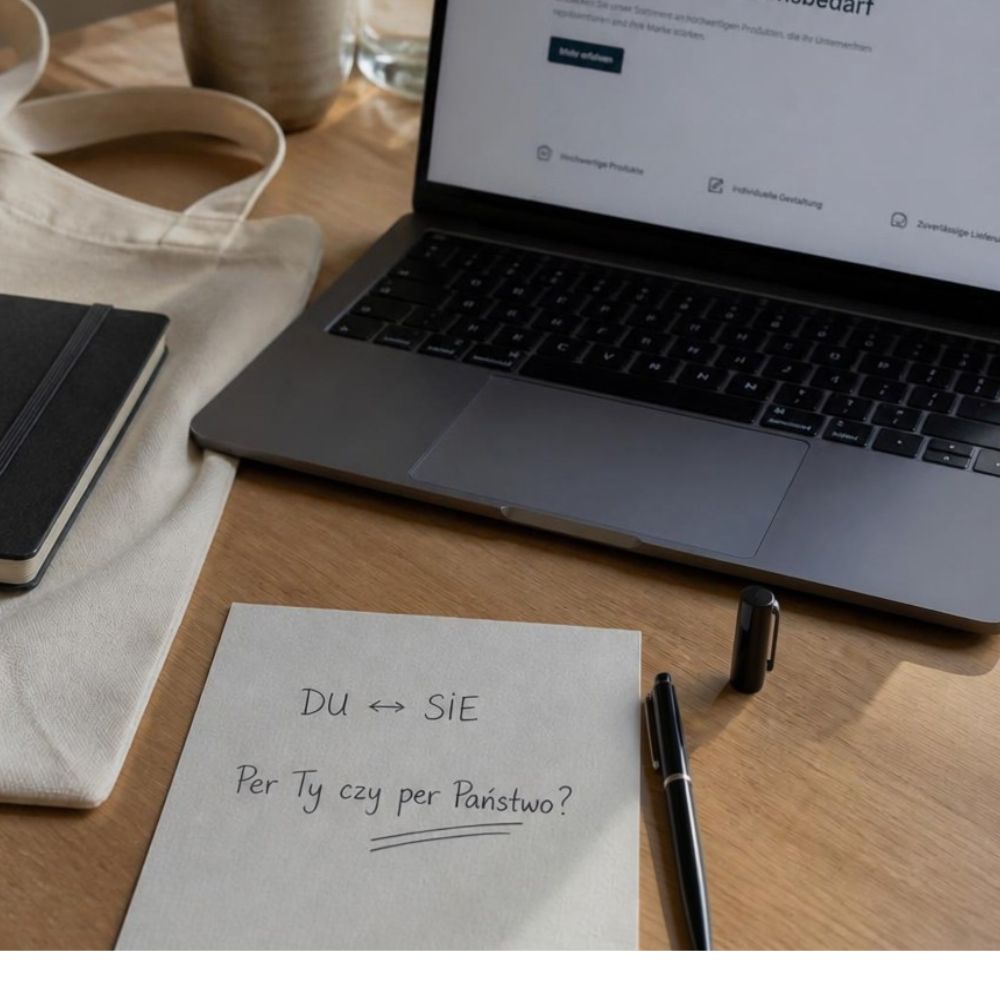
Du or Sie? “Du” or “Sie” in Communication with German Customers
When planning to sell promotional products in Germany, it is worth considering not only a well-prepared translation (localization) of your offer, but also the way you communicate with your target audience. One of the first decisions concerns whether to use “Du” or “Sie.”
There is no single rule that works for every company. The right choice depends on the industry, target audience, brand character, and type of customer relationship.
1. Start with your audience
A promotional products supplier working with large procurement departments may communicate differently from an advertising agency, while a brand targeting younger audiences may take yet another approach.
“Sie” remains a safe choice in many B2B relationships. “Du” is more common in casual, creative, and lifestyle-oriented communication.
2. Do your research
Before localizing your website, catalogue, or offer, take a look at German companies in your industry. How do they address their customers? What do their CTAs and sales communications look like? What tone dominates?
Research does not mean copying the competition. It helps you understand the local context and avoid communication that sounds foreign or unnatural.
3. #gerneperDu is a useful clue
German companies sometimes use the phrase #gerneperDu in their email signatures. This signals that “Du” is a deliberate part of the company’s communication culture. However, it does not mean that every brand should use the same form. Treat such signals as part of your research rather than as a ready-made solution.
4. The form of address is part of your tone of voice
Before localization, it is worth defining whether your brand should sound expert, professional, approachable, casual, or premium.
“Sie” does not necessarily mean formal language, and “Du” does not guarantee a sense of closeness. The form of address should fit the brand’s overall tone of voice.
5. The most common mistakes
❌ automatically translating “you” as “Du”
❌ mixing “Du” and “Sie” – this looks very unprofessional on a website!
❌ copying competitors
❌ translating without doing research first
❌ equating “Du” with a casual communication style
Good communication in German starts not with translation, but with understanding your audience and the local context.
More useful insights on brand communication and visibility
On LinkedIn, Magdalena Nelke shares experiences and insights on brand communication in Poland and international markets.


 +48 791 354 426
 biuro@piap-org.pl